Misunderstanding personal conveyance rules is one of the most common reasons a driver’s log draws unwanted attention during a DOT audit. A single mislabeled Personal Conveyance (PC) entry can flag an entire record for review, chip away at a carrier’s CSA score, and expose the company to liability it never intended to take on.
This guide walks through what FMCSA personal conveyance guidance actually permits, explains where drivers most often go wrong, and explains how TruckX ELD One takes the guesswork out of logging it correctly.

What FMCSA Actually Says About Personal Conveyance Rules
So what is personal conveyance, exactly? According to the Federal Motor Carrier Safety Administration, it is the movement of a CMV vehicle for a driver’s personal use while that driver is off-duty and has no remaining work obligations to the carrier. That definition is the foundation of personal conveyance in every FMCSA guidance document, and it is narrower than many drivers assume; it is not a catch-all for any driving that happens to occur outside of dispatched work.
The One Legal Test Every Driver Must Pass
The rule comes down to a single test that is easy to state but sometimes hard to apply in the moment. First, the driver has to be genuinely relieved of all duty, meaning there is no pending task, delivery, or instruction from the carrier still hanging over them. Second, the movement itself cannot benefit the motor carrier’s operation in any way, whether that means shortening a future dispatch or repositioning equipment for convenience. If a trip fails either half of that test, it does not qualify as personal conveyance, regardless of how the driver intended to use the time.
Laden or Unladen, Does It Matter?
Many drivers still believe a loaded trailer automatically disqualifies a trip from being logged as personal conveyance, but that is no longer accurate under current FMCSA guidance. A CMV can be carrying freight and still qualify for PC status, as long as the movement itself is not advancing that load towards its destination or otherwise serving the carrier’s business. In other words, the cargo status of the vehicle is irrelevant; what matters is the purpose behind the specific trip being logged.
Personal Conveyance Rules
FMCSA has published a set of recognized personal conveyance examples that drivers and safety managers can use as a practical reference:
- Traveling from a driver’s lodging to a nearby restaurant, gym, entertainment venue, etc during off-duty time.
- Commuting between the terminal and the driver’s residence, provided the timing still allows for adequate rest before the next shift.
- Driving to a nearby, safe location to obtain required rest after finishing a loading or unloading task.
- Moving a CMV at the specific request of a safety official while the driver is off-duty.
- Transporting the driver’s own personal property, unrelated to any carrier business, while off-duty.
What Does NOT Qualify
Just as important as knowing what qualifies is understanding what clearly does not. Continuing a dispatched trip after the freight has been dropped off does not count, because that movement is still part of completing the original assignment. Repositioning a truck to make the next load easier to pick up is also excluded, since that directly benefits the carrier. And driving after a driver has been placed out-of-service for exceeding hours-of-service limits is never permissible under PC, no matter how short the distance. Taken together, these exclusions answer the common question of when you can use personal conveyance.
Common Personal Conveyance Violations Fleets Should Watch For
Misuse Pattern #1 — Using PC to finish the trip
Misuse Pattern #2 — Excessive or repeated PC use on the same log
Misuse Pattern #3 — Missing or vague annotations
What Happens If Personal Conveyance Is Misused
When personal conveyance is misused, the consequences extend beyond a single citation. It can be treated as a form of hours-of-service falsification; it can damage a carrier’s CSA score, and it can create liability that follows the company well beyond the individual incident. For anyone who holds CMV driver responsibilities, that risk is worth taking seriously.
How Personal Conveyance Differs for Owner-Operators vs. Fleets
Why Owner-Operators Need Airtight PC Logs
An owner-operator typically does not have a safety department reviewing logs before a roadside inspection happens. That means any mistake in a PC annotation or status switch is discovered in real time, often by an enforcement officer, which makes getting it right the first time, far more important than it might be for a driver working inside a larger fleet.
Why Fleet Managers Need Visibility Into Driver PC Use
Fleet managers, on the other hand, need the ability to see how personal conveyance is being used across every driver on their roster. That visibility allows them to authorize or restrict the status as company policy requires, to review annotations for consistency, and to catch problematic patterns before they turn into a compliance issue during a safety audit.
How TruckX Makes Personal Conveyance Effortless and Audit-Ready
One-Tap Personal Conveyance Status Switching
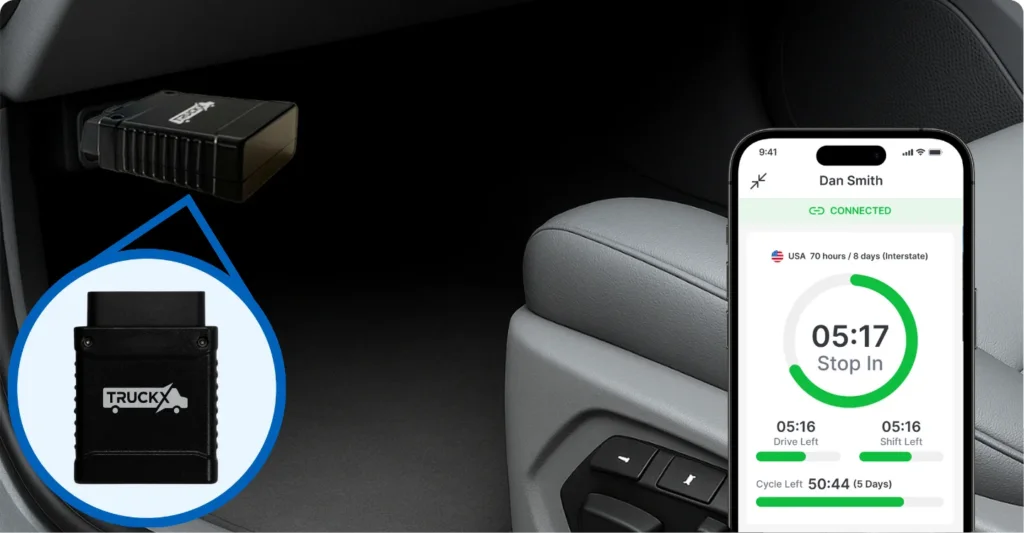
With TruckX ELD One, drivers can switch to PC status in just a few seconds directly from the Logbook Dashboard, without digging through menus or filling out separate paperwork.
Built-In Annotation Prompts
The system prompts drivers to enter a reason for the status change at the exact moment they switch, which directly addresses the vague-annotation problem that causes so many violations during inspections.
Fleet Admin Controls for PC Authorization
Fleet administrators can enable or restrict personal conveyance access on a driver-by-driver basis, which keeps usage aligned with both company policy and the latest personal conveyance rules issued by FMCSA.
Automatic Location Precision Compliance
TruckX automatically applies the reduced location precision that FMCSA requires while a driver is in PC status, so neither the driver nor the fleet manager has to remember to configure it manually.
Audit-Ready Records for DOT Inspections
Every status change, timestamp, and annotation is stored automatically and can be exported cleanly if FMCSA or a safety auditor ever requests a review of a driver’s or fleet’s records.
Final Thoughts
Personal conveyance rules read as fairly simple on paper, but they are surprisingly easy to misapply in the middle of a real workday. TruckX ELD One closes that gap by guiding drivers through correct logging in the moment and giving fleet managers the oversight they need to catch problems early. Explore our Fleet Management and ELD Solutions at TruckX.com or call +1 (650) 600-6007 today to discover more.